
The Real S+4 Fight: Why Gurugram's Infrastructure Crisis Is Also a Battle for the ₹1–2 Crore Buyer
By Abhishek Bhardwaj, founder, Kalpvriksha Realty
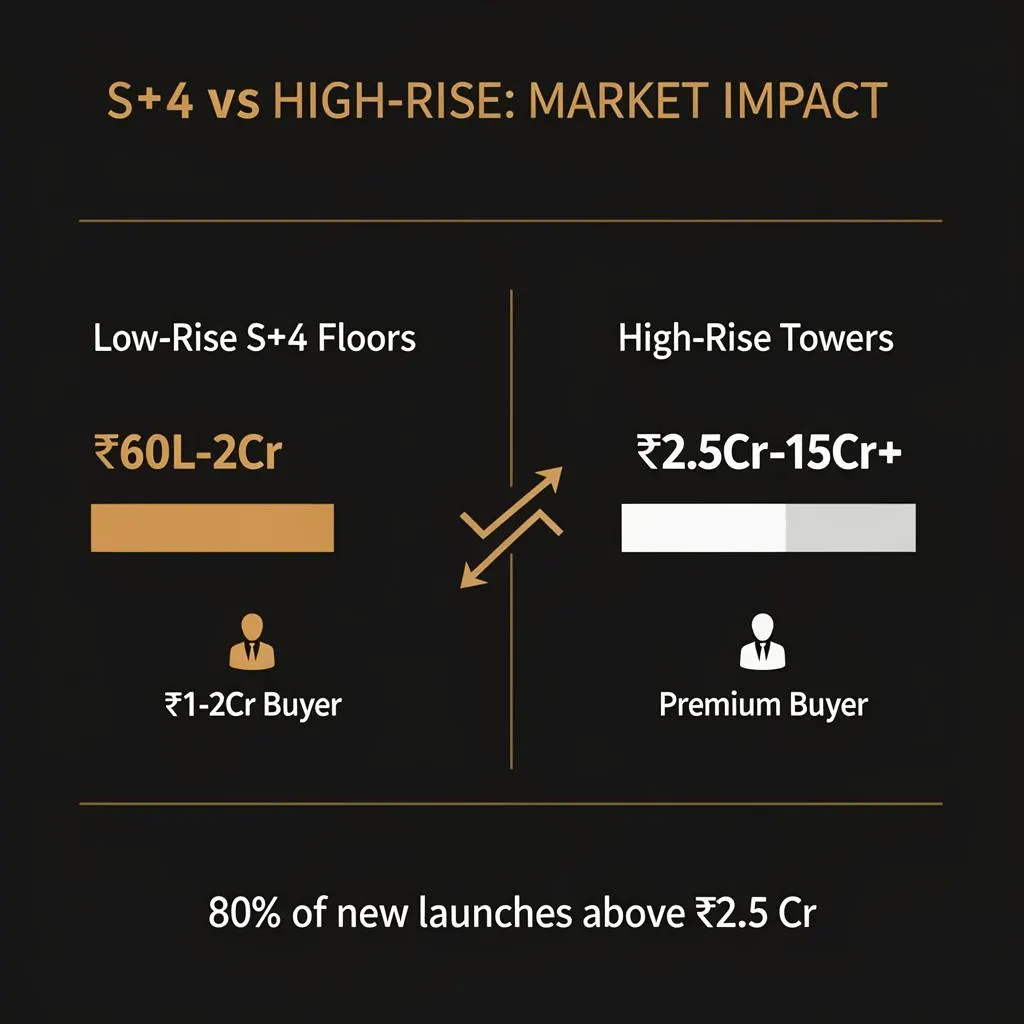
The High Court stay on Stilt+4 is being read as a fight over roads, drainage, and sewage. It is that. But under the civic argument sits a harder market truth: low-rise plotted products had started serving a buyer segment that much of new high-rise Gurugram no longer serves cleanly.
Most people looking at Gurugram's S+4 fight see a familiar civic story.
Residents complained. The court intervened. Road width, sewage, drainage, and parking became the headline.
That headline is not false. Haryana's July 2, 2024 order revived approval of Stilt+4 floors on residential plots. On April 2, 2026, the Punjab and Haryana High Court stayed the operation of that policy, and the court record and subsequent reporting focused heavily on infrastructure stress, especially narrow usable carriageway, sewage, drainage, and public-safety concerns.
But if you stop there, you miss the more important story.
This is also a fight over the buyer in Gurugram who has roughly ₹1 crore to ₹2 crore to spend, wants ownership that feels usable, and does not want to stretch into a much more expensive high-rise ticket.
That buyer has been quietly squeezed out of large parts of new-launch Gurugram. A late-2025 market report cited by Business Standard said roughly 80% of new projects in Gurugram were priced above ₹2.5 crore. That does not mean nothing exists below that level. It does mean the centre of gravity of new supply has moved sharply upward.
That is where the low-rise product matters.
What the court fight is really about on the surface
The surface case is serious.
The High Court stay did not appear out of thin air. Reporting around the April 2026 order says the court relied on findings that roads marked as 10 to 12 metres wide were, in some inspected stretches, only about 3.9 to 4.8 metres motorable on the ground. The court also questioned how the state could permit added density without first carrying out the kind of infrastructure-capacity audit that its own earlier expert process had contemplated.
No serious buyer should dismiss that.
Paper road width does not equal usable road width. Permitted density does not equal proven civic capacity.
Those are valid concerns.
But they are not the whole market story.
The Gurugram market changed while the legal fight was running
While the legal and policy back-and-forth continued, Gurugram's housing market moved up the value chain.
Luxury and premium housing became the city's dominant public story. By 2025, Gurugram was seeing unusually strong premium and ultra-luxury activity, and even broader NCR reports were showing that new supply had tilted heavily toward luxury and ultra-luxury bands. That is great for developers serving the top of the market. It is much less helpful for the buyer trying to stay disciplined inside the ₹1–2 crore bracket.
That buyer is not weak. That buyer is not unserious. That buyer is simply refusing to overpay for a product that often gives less usable daily space than the headline brochure suggests.
This is the part the average policy article misses.
The S+4 conflict is not only about whether Gurugram can absorb more floors.
It is also about what happens when a lower-ticket ownership product starts working again for a buyer segment that expensive high-rise inventory had pushed aside.
Why low-rise builder floors started landing with budget buyers
The math is not mysterious.
Take a 180 sq yd plot. That is about 1,620 sq ft of land.
Use a practical 75% coverage lens and one floor comes to roughly 1,215 sq ft.
That is not tiny. That is a serious compact floor plate. It can work as a strong 2 BHK or a compact 3 BHK, depending on design.
Now compare that with the lived experience of many buyers entering a "2,000 sq ft" high-rise apartment. In real projects, loading absorbs a meaningful chunk of what buyers think they are purchasing. But as a market reality, buyers routinely discover that a large super built-up apartment does not always feel dramatically superior in daily usable space to a well-planned low-rise floor.
Now take a 120 sq yd plot.
That is about 1,080 sq ft of land.
At the same practical 75% lens, one floor comes to about 810 sq ft.
For a large share of first-time buyers, that is not a compromise product. That is a proper, affordable 2 BHK. It is a home they can realistically buy.
This is why the low-rise floor began to matter so much.
It was not only cheaper. It was more direct.
You were paying for usable ownership. Not only for a tower, a lobby, a clubhouse, and loading.
Why DDJAY matters in this story
DDJAY was not accidental.
The 2016 DDJAY policy was designed as an affordable plotted housing framework. The policy document capped residential plot size at up to 150 square metres, allowed FAR of 2.0 on residential plots up to that size, and prescribed minimum internal road width of 9 metres within the colony.
That matters because DDJAY created a formal structure for smaller plotted products.
Not luxury plots. Not sprawling villas. Smaller, denser, regulated plotted stock.
Once independent floors, stilt parking logic, and the economics of floor-wise sale come into the picture, you get a housing product that can bring the ₹1–2 crore buyer back into ownership without forcing them into the pricing logic of a premium high-rise.
That is why DDJAY and peripheral low-rise pockets matter so much in this debate.
They reopened a price band that had become progressively harder to access through new high-rise supply.
Where the official logic starts wobbling
The infrastructure critique is valid.
The asymmetry is where the debate becomes uncomfortable.
DDJAY's planning framework is built around 9 metre internal roads. Yet the broader S+4 conversation in HSVP and other plotted contexts has been shaped around the 10 metre road threshold and, now, around the court's findings that even nominally wider roads can shrink sharply in usable motorable width on the ground.
That raises a fair market question.
If a nominal 12 metre road can, in reality, function like a 4 or 5 metre carriageway because of bad design, paving, encroachment, and cumulative misuse, then the problem is not born only at S+4.
The planning failure already exists.
You cannot pretend the city was fully healthy at S+3 and suddenly broken at S+4. That is too neat. Too convenient. And not intellectually honest enough for a serious buyer.
The stronger reading is this:
Gurugram has a genuine infrastructure problem. But it also has a product-competition problem. Both are happening at the same time.
The market conflict nobody wants to state plainly
Here is the cleanest version.
High-rise sells lifestyle, amenities, scale, and corridor prestige.
Low-rise sells usable space, lower ticket size, independence, and a stronger feeling of direct ownership.
Those products are different.
But they still compete for the same buyer once the buyer is budget-sensitive and does not want to overextend.
That is why the S+4 conflict matters beyond law and planning.
A working low-rise floor in a peripheral or DDJAY-type pocket can pull a buyer out of the high-rise funnel entirely.
Not because the buyer hates towers. Because the buyer prefers utility over excess stretch.
This does not prove that high-rise builders are behind petitions. That claim needs proof, and no such proof should be inserted casually.
But it is fair to say something else.
There is a market incentive for the high-rise ecosystem to support any narrative that weakens competing low-rise affordability.
That is not conspiracy language. That is market structure.
When a cheaper competing product starts serving the same buyer more effectively, existing higher-priced products do not remain neutral in commercial effect.
What the ₹1–2 crore buyer should understand from this fight
If you are that buyer, the core issue is not only whether the court eventually allows or restricts S+4.
The core issue is what kind of housing Gurugram is still willing to let you buy.
Because the market already has a gap.
A significant share of new high-rise supply has moved above your comfort zone.
Low-rise plotted floors had started filling that gap.
Not perfectly. Not everywhere. Not without civic questions.
But they were filling it.
That is why this fight has become so important.
It is not only a legal dispute over road width.
It is also a battle over whether cheaper low-rise ownership is allowed to compete with expensive high-rise inventory on equal terms.
The correct way to hold both truths together
You do not need to romanticize S+4.
And you do not need to romanticize the status quo either.
The honest position is harder.
Yes, Gurugram's infrastructure stress is real. Yes, the court's concern deserves respect. Yes, density without capacity is dangerous.
And yes, it is also true that low-rise plotted products had started serving an underserved buyer band in a way much of new-launch high-rise Gurugram no longer does.
That is the real S+4 fight.
Not roads versus greed. Not residents versus builders.
A deeper conflict.
Infrastructure versus unplanned density, yes.
But also product versus product. Ticket size versus affordability. Prestige versus utility. Loading versus usable ownership.
If you miss that second layer, you understand the case. But you still miss the market.
Explore more Deep Dives · Read Insights · Use Decision Tools · Connect with us
Related Micro-Markets
The S+4 fight affects each Gurugram corridor differently. Explore the specific dynamics:
- Dwarka Expressway — How the supply wave and S+4 stay intersect in Sectors 84–115
- Golf Course Extension — Premium corridor impact and infrastructure realities
- Southern Peripheral Road — The mid-segment squeeze and metro dependency
- Sohna Road — Where DDJAY inventory and the S+4 stay hit hardest
- New Gurugram — Sectors 102–110: ground zero for the affordability battle
Read next
Gurugram micro-market guides
Every corridor I cover, read the same way: price, supply, road, and who should buy.
Read moreThe Resale Seller's Blind Spot: Why Gurugram Sellers Are More Exposed Than They Think
India protects property buyers through RERA and courts, but Gurugram resale sellers face weak token, KYC, broker, and time-loss safeguards.
Read moreSecond opinion before you pay a token
Rs 25,000 for a written opinion on up to 3 properties or markets.
Read more