
Apr 28, 2026
The Resale Seller's Blind Spot: Why Gurugram Sellers Are More Exposed Than They Think
India protects property buyers through RERA and courts, but Gurugram resale sellers face weak token, KYC, broker, and time-loss safeguards.

Abhishek Bhardwaj
Founder, Kalpvriksha Realty
Independent Advisor | Pan-Gurugram
What you will learn in this article:
- →Why India's property protection framework is structurally buyer-first
- →Where RERA helps and where it does not help in a resale transaction
- →Why token money is not protection unless the agreement is drafted properly
- →How buyer delay creates a real seller-side loss even when no fraud occurs
- →Why Gurugram resale sellers need buyer KYC before token, not after
- →What NRI sellers must be extra careful about before using a Power of Attorney
- →What a seller-protective resale transaction framework should include
A resale seller in Gurugram usually thinks the hard part is finding a buyer.
That is not always true.
The hard part is often finding a buyer who is real, funded, documented, decisive, and willing to close within a clear timeline. Until that is established, the seller is not in control. The seller is only holding an asset while other people test the market with the seller's time.
India's property safety conversation is built around one assumption: the buyer is vulnerable, the seller is powerful. That assumption is sometimes correct. Developers have delayed projects. Sellers have hidden title defects. Buyers have paid life savings into weak paperwork. RERA, buyer checklists, consumer forums, legal due diligence, and property-fraud awareness material all grew out of that reality.
But Gurugram's modern resale market has created a different problem. The individual seller is not a developer. The NRI owner is not an institution. The family selling one apartment is not sitting with a legal department. The owner-investor trying to exit a luxury flat does not have a regulator designing a resale process for him.
Possession is not the same as protection.
The Default Assumption: Buyers Need Protection, Sellers Do Not
India's real estate regulation was built in response to buyer pain.
The Real Estate (Regulation and Development) Act, 2016 was framed to regulate real estate projects, improve transparency, protect consumer interest, and create an adjudicating mechanism for disputes. Its operative safeguards are largely aimed at the promoter-allottee relationship: project registration, disclosures, limits on advances before agreement, delivery timelines, defect liability, and refund or compensation in cases of promoter default.
Section 13 of RERA restricts a promoter from taking more than 10 percent of the apartment, plot, or building cost before entering into a written agreement for sale. Section 18 gives buyers remedies when a promoter fails to complete or deliver possession as promised. Section 9 requires real estate agents facilitating transactions in registered projects to be registered.
These are necessary protections. They should exist.
But the architecture is revealing. RERA is not designed as a complete resale transaction code between two private individuals. A completed apartment sold by one owner to another is still mainly governed by older legal frameworks such as the Transfer of Property Act, the Indian Contract Act, the Registration Act, and the Specific Relief Act. These laws create rights and remedies, but they do not create a clean pre-token resale process.
That is the blind spot.
The buyer gets a protection conversation before paying. The seller usually gets a broker saying: "Genuine buyer hai, token kar do."
The Popular Narrative
The popular narrative is simple: sellers have the property, so sellers have power.
There is some truth in it. A seller with a clean title, possession, documents, and patience can refuse weak buyers. A seller can draft an Agreement to Sell with clear default clauses. If the buyer defaults, earnest money may be forfeitable if the contract is properly drafted and the seller is not in default. In some cases, sellers can seek contractual remedies.
So the argument is not that Indian law gives sellers no protection.
The argument is sharper: India's resale process gives sellers no standardized, fast, transaction-stage protection against buyer unseriousness, identity opacity, funding uncertainty, token disputes, and time loss.
Courts can decide disputes. But most seller damage begins before the matter is worth litigating.
A buyer can negotiate for weeks, ask for documents, do repeated visits, claim loan processing is underway, pay a small token, push the registry date, renegotiate after the seller has gone cold on other leads, and then disappear or dispute refund. The seller may technically have remedies. Practically, the seller has lost time, leverage, market momentum, and sometimes another deal.
No regulator is measuring that loss.
The Core Insight
The buyer's risk is usually title, delivery, possession, and disclosure.
The seller's risk is seriousness, timeline, payment certainty, identity, and enforceability.
That difference matters.
In a primary sale, the buyer faces a large institution. RERA was built for that imbalance. In a resale transaction, the seller is often an individual facing an informal chain of buyers, brokers, lawyers, bankers, relatives, and document handlers. The system assumes the seller can protect himself because he has possession.
But in Gurugram resale, possession does not protect against a buyer who blocks your deal and wastes your exit window.
Buyer Protection vs Seller Protection
| Transaction Issue | Buyer-Facing Protection | Resale Seller Equivalent |
|---|---|---|
| Builder delay | RERA refund, interest, compensation routes | No equivalent for buyer delay before strong contract |
| Project disclosure | RERA portal disclosures | No standard buyer seriousness disclosure |
| Advance before agreement | RERA limits promoter advance collection | No standard resale token protocol |
| Broker accountability | RERA agent registration in registered projects | No standard buyer-screening obligation |
| Title risk | Buyer legal due diligence ecosystem | Seller must manage document exposure and buyer credibility |
| Fraud prevention | Police advisories mostly warn buyers | Seller-side fraud categories are not tracked clearly |
| Time loss | Rarely compensated | Usually invisible unless contract creates remedy |
This matrix shows why seller risk is real but less formally named. The buyer has a mature protection conversation. The seller usually has to create the process privately.
What The Gurugram Resale Market Actually Looks Like
Gurugram is not a sleepy resale market.
The city has deep end-user demand, investor exits, luxury apartment churn, NRI ownership, high-ticket secondary transactions, and broker-led matching across WhatsApp groups, phone networks, private mandates, and informal references.
CRE Matrix reported that Gurugram recorded INR 24,120 crore of INR 10 crore-plus luxury home sales in CY2025, across 1,494 homes, with an average ticket size of about INR 16 crore. This is not resale-only data, so it should not be used as a direct resale volume statistic. But it does prove something important: Gurugram's high-value housing market is large enough that transaction discipline is not optional anymore.
The fraud context also matters. Public reports in late 2025 and early 2026 highlighted serious Gurugram property fraud cases, including a reported INR 12 crore non-existent luxury flat case linked to forged documents and verification gaps in broker-led resale circulation, and a reported INR 500 crore commercial property fraud case involving alleged multiple sales of the same unit. These cases are mostly buyer-harm cases, not pure seller-harm cases.
But they prove the same structural point: Gurugram's property market still depends too much on informal verification after momentum has already built.
For sellers, that means one thing: do not wait for fraud to look dramatic before tightening the process.
Three Structural Vulnerabilities Every Resale Seller Carries
1. No Standard Token-Money Framework
Most resale sellers think token money protects them.
It does not automatically.
Token protects the seller only when it is supported by clean paperwork. The Agreement to Sell should define whether the payment is earnest money, what counts as buyer default, how many days the buyer has to complete payment, whether delays attract penalty, when forfeiture applies, what happens if documents are incomplete, and which forum or jurisdiction applies.
Without that, token money can become the beginning of the dispute, not the end of uncertainty.
The dangerous version is a small token, loose WhatsApp confirmation, no proof of funds, no hard closing date, and a buyer who keeps asking for time.
2. No Serious Pre-Token Buyer Verification Norm
In a high-value resale transaction, sellers often share documents before the buyer has been meaningfully verified.
That is backwards.
A seller should not hand over full document sets to every person who can arrange a site visit. A serious buyer should be able to share basic identity, PAN, funding route, loan status, decision-maker identity, and expected payment timeline before the seller takes the property off the market.
The buyer has the right to conduct due diligence. But the seller has the right to know whether the buyer is real before allowing the transaction to consume time.
3. No Real Compensation For Time Loss
This is the seller's most ignored risk.
If a buyer blocks the property for 45 days and then exits, the seller rarely recovers the true loss. The seller may lose another buyer. The listing may appear stale. Brokers may restart price pressure. Family plans may get delayed. In an investor exit, the opportunity cost can be material.
Indian contract law can address damages in principle. But practical recovery requires proof, contract language, time, money, and willingness to litigate.
Most sellers do not litigate time loss. They absorb it.
Resale Seller Exposure Funnel
| Stage | Seller Gives | Buyer Should Give | Seller Risk If Missing |
|---|---|---|---|
| Inquiry | Time and basic details | Identity and buying intent | Tyre-kicking and fake urgency |
| Site visit | Access to property | Decision-maker clarity | Repeated visits with no closure |
| Document sharing | Sensitive paperwork | KYC and proof of funds | Document misuse or time waste |
| Token | Property taken off-market | Written terms and default triggers | Token dispute and weak leverage |
| Agreement to Sell | Legal commitment | Payment schedule and funding proof | Delay without clear default |
| Registry | Final transfer | Full payment and compliance | Last-minute renegotiation |
Seller exposure starts before the Agreement to Sell. The most dangerous stage is when the property is emotionally or practically off-market but buyer verification is still weak.
What A Seller-Protective Transaction Framework Requires
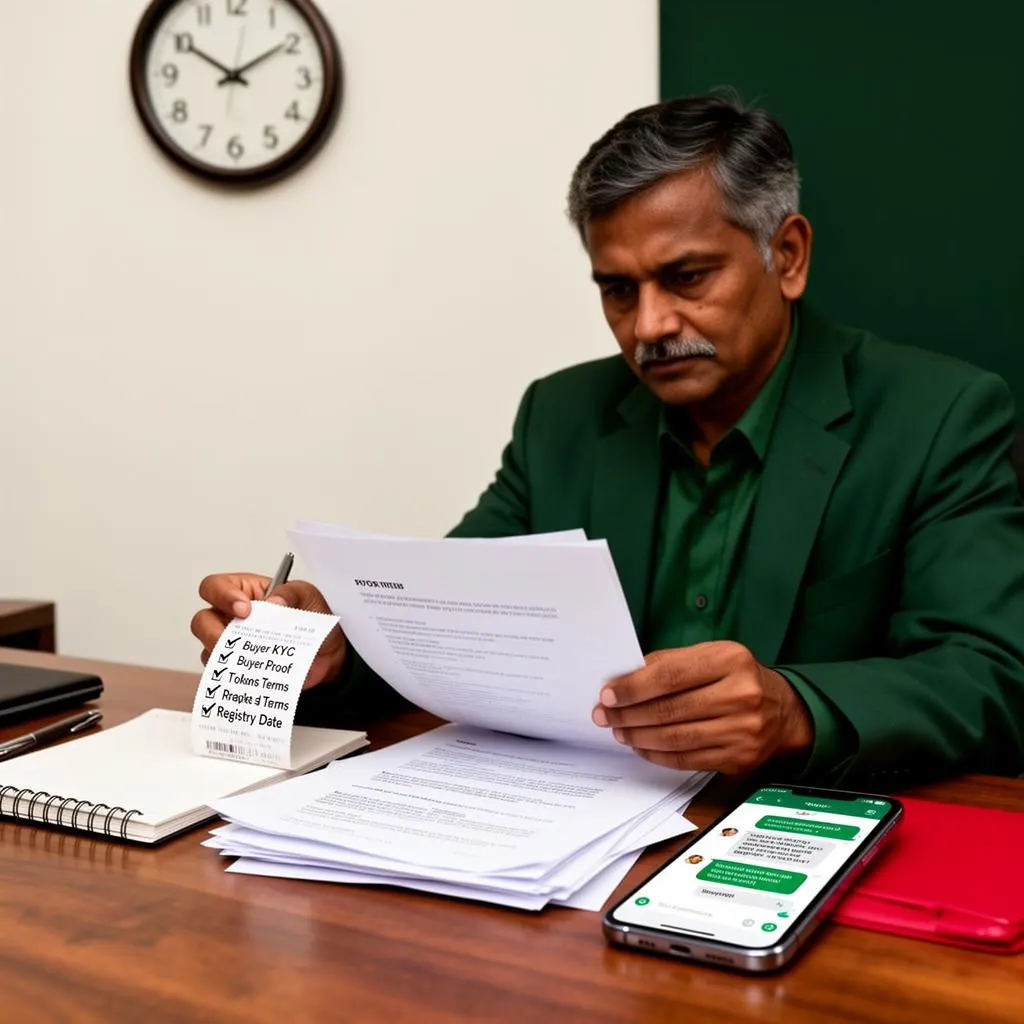
A serious resale transaction should not start with "token do." It should start with a filter.
The 7-Step Seller Protection Framework
1. Verify identity — Buyer KYC, PAN, address, funding route, and decision-maker identity before sharing full documents. For company buyers, verify board authority or authorization.
2. Confirm funds — Self-funded, loan-sanctioned, or only verbal? If bank-funded, understand whether the loan is sanctioned, pre-approved, or only verbally assumed.
3. Written token receipt — Not a vague WhatsApp line. State amount, property, parties, timeline for Agreement to Sell, refund and forfeiture triggers, and pending documents.
4. Draft ATS early — Define timelines, payment schedule, buyer default, seller default, forfeiture, extensions, jurisdiction, taxes, TDS, possession, and registry obligations.
5. Hard timeline — No open-ended "loan process chal raha hai." A buyer who needs financing must be given a defined window and consequences for delay.
6. Broker check — Work with a RERA-registered agent where applicable. Ask who verified the buyer, who introduced the buyer, and who is responsible for coordination.
7. Keep leverage — Do not publicly panic, but do not emotionally stop marketing after a weak token. Until the buyer is verified and the agreement is signed, the transaction is not closed.
Token Money Risk Timeline
| Day | Event | Weak Process | Strong Process |
|---|---|---|---|
| Day 0 | Buyer pays token | WhatsApp confirmation | Signed token receipt with KYC |
| Day 3-7 | Documents reviewed | Buyer asks for more time | Document list and deadline fixed |
| Day 10-15 | Agreement expected | Drafting starts late | Agreement draft already approved |
| Day 30 | Payment due | Buyer says loan pending | Default or extension clause activates |
| Day 45+ | Deal stalls | Seller loses momentum | Forfeiture, penalty, or exit path defined |
Token money is not protection unless the terms are written, time-bound, and connected to buyer default triggers.
Gurugram-Specific Application
Luxury Apartments
In Gurugram luxury resale, ticket sizes are high and informal broker velocity is fast. A forwarded PDF, a voice note, or a "buyer is ready" message is not enough. The higher the ticket size, the more disciplined the seller should be with buyer identity, proof of funds, and written timelines.
NRI Sellers
NRI sellers face a sharper version of the same problem. Distance creates dependence on relatives, brokers, lawyers, caretakers, and Power of Attorney holders. A PoA is not automatically unsafe, but a broad, poorly monitored PoA can create risk. Use limited powers, clear property description, defined validity, and direct confirmation at each transaction stage.
Family Sellers
Family sellers often sell for a reason: upgrade, inheritance division, relocation, debt cleanup, children's education, or reinvestment. Their biggest risk is not just fraud. It is delay. A weak buyer can disturb the family's next move.
Investor Exits
Investor sellers are exposed to timing. If a buyer blocks the deal during a strong market window and exits later, the seller may lose the price, not just the buyer.
Practical Checklist Before Accepting Token
- Has the buyer's identity been verified?
- Is the buyer buying personally, through family, through a company, or through a nominee?
- Has the funding route been explained clearly?
- Is the broker RERA-registered where required?
- Is the buyer asking for full documents before showing seriousness?
- Is the token receipt drafted or only verbal?
- Does the Agreement to Sell define buyer default clearly?
- Is there a hard registry or payment deadline?
- Are TDS, tax, loan, and bank formalities mapped before signing?
- For NRI sellers, is the PoA limited, current, and independently checked?
- Has the seller kept a written trail of every material communication?
- Has a lawyer reviewed the agreement before the seller takes the property off-market?
Conclusion
The resale seller is not powerless.
But the resale seller is less protected than the market assumes.
RERA improved buyer protection in primary transactions. Courts can enforce contracts. Police can investigate fraud. Lawyers can draft stronger agreements. None of this replaces a standardized seller-side process before token money.
That is the blind spot.
In Gurugram resale, the seller should stop treating every interested person as a buyer. Interest is not intent. A site visit is not credibility. Token is not protection unless the terms are written. A broker's confidence is not buyer verification.
Before accepting token, the seller needs a framework, not hope.
Source Notes
- India Code, Real Estate (Regulation and Development) Act, 2016 — RERA's statutory structure
- RERA Section 9 — agent registration requirement in RERA-registered projects
- RERA Section 13 — 10 percent advance limit before written agreement for sale
- HRERA Gurugram Annual Report FY2024-25 — 820 agents registered, 282 renewals during FY2024-25
- HRERA Gurugram advisory (ETRealty, January 2026)
- CRE Matrix Gurugram ultra-luxury CY2025 report
- Times of India — INR 12 crore ghost flat fraud
- Moneycontrol — alleged INR 500 crore 32nd Avenue case
This article is for market education, not legal advice. A seller should use a property lawyer for transaction documents and tax advice before accepting token or signing an Agreement to Sell.
Read next
Gurugram micro-market guides
Every corridor I cover, read the same way: price, supply, road, and who should buy.
Read morePossession Letter Is Not Possession
A real buyer case that explains why homebuyers should never accept possession without checking the Occupation Certificate.
Read more₹10,000 if you want this read on your specific flat
A written buy, avoid or wait on the flat you've shortlisted, with the reasons.
Read moreGet A Second Opinion Before Token Money
At Kalpvriksha Realty, the job is not only to find the other side of the deal. The job is to check whether the deal can close cleanly. A high offer from a weak buyer is not always better than a slightly lower offer from a verified buyer with clean funds, clear intent, and a fixed timeline.
Speak with Abhishek BhardwajAbhishek Bhardwaj
Founder, Kalpvriksha Realty
Independent Advisor | Pan-Gurugram