
Apr 26, 2026
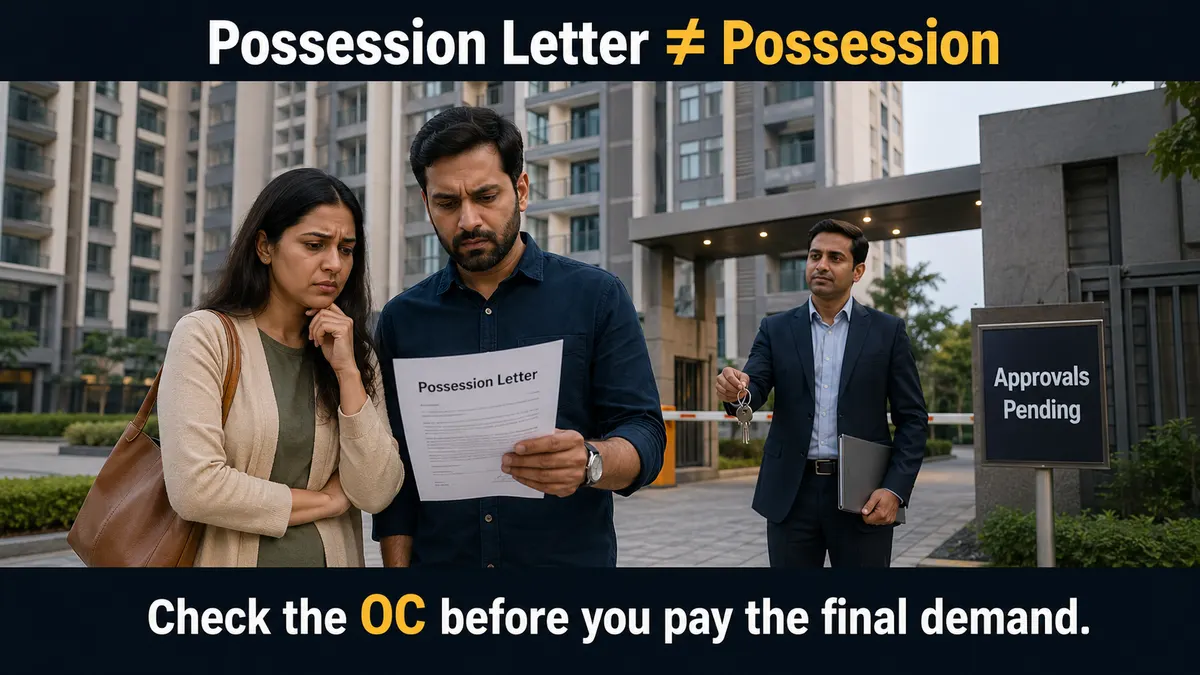
Possession Letter Is Not Possession
A real buyer case that explains why homebuyers should never accept possession without checking the Occupation Certificate.

Abhishek Bhardwaj
Founder, Kalpvriksha Realty
Independent Advisor | Pan-Gurugram
What you will learn in this article:
- →Why a possession letter from a builder is not the same as legal possession
- →What the Occupation Certificate actually proves and why it matters before the final demand
- →Where buyers get trapped at the possession stage even after negotiating well at booking
- →A clear checklist of documents to verify before paying the final demand
- →How to treat possession as a risk point, not just an event
The Short Version
A builder said possession was offered.
The buyers said it was not valid possession.
Why?
Because there was no Occupation Certificate.
The appellate tribunal agreed.
That one detail changes everything.
The Story
Rachna Grover and Sanjay Grover had booked a unit in Tuscan Heights, TDI City, Kundli. The promised possession date had passed years earlier.
Later, the builder argued that possession had been accepted. But the buyers raised a simple point.
A possession offer without an Occupation Certificate is not valid possession.
The tribunal agreed with the buyers. It held that without an Occupation Certificate, there was no valid offer of possession. It also held that signing documents could not defeat the buyers' statutory rights under RERA.
That is the part every homebuyer should understand.
Possession is not just a letter.
Possession is not just a call from CRM.
Possession is not just a final demand notice.
Possession is not just a key handover photo.
Possession has to be backed by approvals.
Where Buyers Usually Get Trapped
Most buyers become careful at booking. They compare prices. They negotiate payment plans. They ask about PLC, floor rise, club charges, parking, and maintenance.
But near possession, many buyers become tired. They just want the home.
That is where mistakes happen.
A final demand arrives. The builder says possession is ready. The buyer feels pressure. Family starts planning interiors. The bank starts asking for documents. The CRM team keeps following up.
And suddenly, the buyer starts treating paperwork as a formality.
It is not a formality. The possession stage is one of the biggest risk points in the entire homebuying journey.
A quick gut-check is useful here: Talk to Abhishek before you commit.
What the Order Teaches
The key lesson is simple. A possession letter cannot replace an Occupation Certificate.
An Occupation Certificate confirms that the building has received the required approval for occupation. Without it, a buyer must be careful before treating possession as valid.
This matters because many liabilities can start getting pushed onto the buyer at possession stage.
Final demand. Maintenance. Holding charges. Fit-out conditions. Possession paperwork. Interest calculations. Delay claims.
Once the buyer signs without checking, the situation becomes harder. Not always impossible. But harder.
The Buyer Mistake This Story Helps Avoid
The mistake is not trusting the builder.
The mistake is trusting the wrong document.
A possession letter is a communication. An Occupation Certificate is an approval. They are not the same thing.
A buyer should never confuse urgency with legality.
Buyer Checklist Before Accepting Possession
Before accepting possession, check:
Occupation Certificate — the single most important document at this stage.
Completion Certificate, if applicable for the project.
Final demand breakup — every line item, every charge.
Delay interest calculation — if the project is past its committed possession date.
Maintenance start date — when does your liability actually begin.
Club charges and IFMS — what you are paying for and when.
Any new charge not mentioned in the buyer agreement.
Whether possession is being offered for fit-out or final handover — these are very different.
Whether common areas and access are actually usable.
Do not only check the apartment. Check the paperwork behind the apartment.
For a structured way to pressure-test the demand itself, use buyer decision tools before paying a final demand.
A Buyer-First Possession Review Can Save Serious Money
Most buyers negotiate hard at booking. Then they become casual at possession.
That is risky.
The final demand stage is where extra charges, missing approvals, delayed interest, maintenance dates, and agreement clauses all meet.
At Kalpvriksha Realty, we help buyers read this stage before they pay, accept, or sign. We do not look at possession as an event. We look at it as a risk point.
If you want context on how builder, timeline, and approval risks compound, read long-form Gurugram buyer risk analysis. Or speak to Kalpvriksha Realty before accepting possession.
Moral of the Story
A possession letter opens a conversation. An Occupation Certificate opens the door.
Frequently Asked Questions
Is a possession letter the same as legal possession?
No. A possession letter alone is not enough. Buyers should check whether the project has received the Occupation Certificate or other required approvals.
What is an Occupation Certificate?
An Occupation Certificate is an approval that confirms the building is fit for occupation after meeting required norms.
Should I pay the final demand before seeing the OC?
A buyer should not blindly pay the final demand without checking the OC, the final demand breakup, and the buyer agreement.
Can a builder charge maintenance before valid possession?
This depends on the agreement and approval status. Buyers should check when maintenance liability actually starts.
What should I check before accepting possession?
Check the OC, completion status, final demand, delay interest, extra charges, maintenance start date, and whether the builder is demanding anything beyond the agreement.
Disclaimer
This is a simplified educational summary of a public order and should not be treated as legal advice.
Read next
Gurugram micro-market guides
Every corridor I cover, read the same way: price, supply, road, and who should buy.
Read moreThe Resale Seller's Blind Spot: Why Gurugram Sellers Are More Exposed Than They Think
India protects property buyers through RERA and courts, but Gurugram resale sellers face weak token, KYC, broker, and time-loss safeguards.
Read more₹10,000 if you want this read on your specific flat
A written buy, avoid or wait on the flat you've shortlisted, with the reasons.
Read moreGot a final demand letter? Let's review it before you pay.
A buyer-first possession review covers the OC status, the final demand breakup, delay interest, and any charges that should not be there. Twenty minutes can save serious money.
Review my possession demandAbhishek Bhardwaj
Founder, Kalpvriksha Realty
Independent Advisor | Pan-Gurugram