
How to Find the Real Price of a Gurugram Flat When the Listed Price Is Designed to Mislead You
By Abhishek Bhardwaj, founder, Kalpvriksha Realty
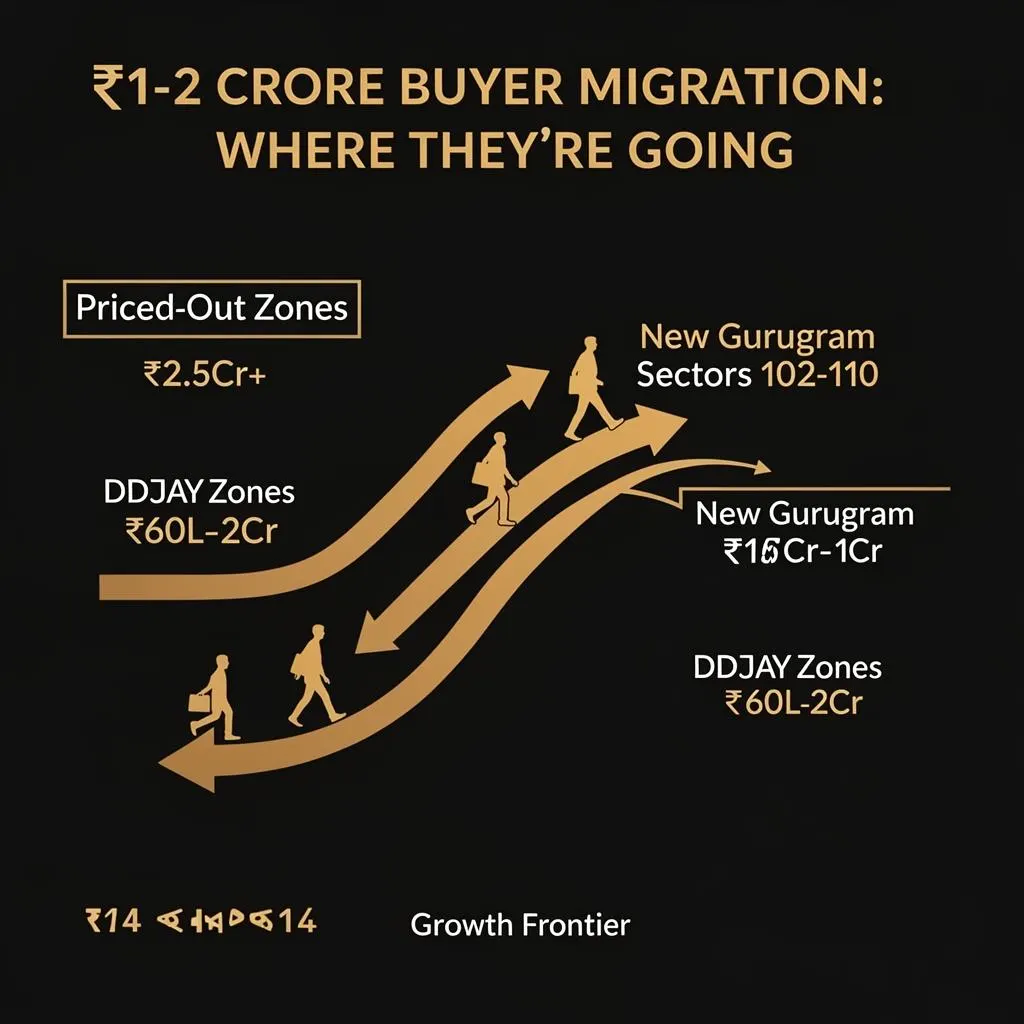
The number on the builder's portal is not a market price. It is a floor -- constructed carefully to protect the investor's exit narrative. Sales fell roughly 14% city-wide while quoted prices climbed 23% in certain corridors. When volume falls and prices hold or rise, you are looking at a market being maintained, not discovered.
This piece breaks down five verifiable signals -- using HRERA filings, IGRS transaction data, stamp duty math, and public infrastructure records -- that tell you what the flat actually costs and which corridor cracks first.
Why City-Level Data Is the Wrong Unit of Analysis
Gurugram is not one market. It is at least three distinct corridors operating on different supply cycles, buyer profiles, and infrastructure timelines. A city-wide average price obscures the only thing that matters: what is happening in the specific corridor, sector, and project where you are putting your money.
When someone quotes you a "Gurugram average price," they are blending Dwarka Expressway investor flats with Golf Course Extension end-user apartments with Sohna Road mid-tier launches. The average tells you nothing. The corridor tells you everything.
Signal 1: The Price Bracket Tells You Who Holds the Flats
Every price band attracts a different buyer profile, and each profile has a different breaking point.
Above Rs.5 crore: NRI and HNI only. Pure appreciation play. Post-tax rental yields run 1.8-2.4%. This segment weakens when the rupee firms or NRI job markets thin. These buyers can wait, but they also exit quietly when the narrative shifts.
Rs.2-5 crore: GCC salaried professionals and investors. Gurugram's GCC economy employs 250,000+ directly. This is the engine of Gurugram's residential demand. It cracks when the job market softens -- and GCC hiring cycles are visible in quarterly earnings before they hit real estate sentiment.
Below Rs.2 crore: End-user dominant. Most resilient because these buyers need a home, not a return. But this segment barely exists now -- 82% of new NCR launches in 2024 cleared Rs.1.5 crore base price. The affordable buyer has been priced out of new Gurugram.
Know which bracket your target flat sits in. That tells you who your co-owners are and what makes them sell.
Signal 2: Delivered Infrastructure vs. Promised Infrastructure
Infrastructure drives real estate narratives. But there is a critical difference between infrastructure that is operational and infrastructure that is promised.
Dwarka Expressway is now operational. Prices doubled between 2019 and 2024 -- from Rs.9,400/sqft to Rs.18,500-19,000/sqft. The story has been delivered. The upside is priced in. Anyone buying here now is paying for yesterday's catalyst.
Southern Peripheral Road (SPR) metro is still 18-24 months out. Sohna's story is still building. This is where timing matters -- but only if you verify the timeline independently.
How to verify: Go to pib.gov.in for official infrastructure project status updates. Do not trust builder timelines. Builders announce infrastructure milestones that have not been sanctioned. The Press Information Bureau publishes what has actually been approved and funded.
Signal 3: Count New HRERA Registrations in Your Corridor
Supply is not what builders announce at launches. Supply is what gets registered with HRERA.
Go to haryanarera.gov.in. Count new project registrations in your corridor over the last 12 months and compare with the previous 12 months.
In 2023, Dwarka Expressway saw 11,270 units launched -- 69% of all Gurugram launches, up 166% from the previous year. Those units approach possession in 2025-2027. That is a supply wave hitting a corridor where investors already dominate.
Rising registrations mean supply is entering the pipeline. More supply against the same demand means price support weakens. This is not speculation -- it is arithmetic.
Signal 4: The Payment Plan Type Buried in the HRERA Filing
The payment plan structure tells you how dependent the builder is on buyer cash flow.
Construction-Linked Plan (CLP): You pay as floors rise. The builder has project finance arranged. Construction proceeds independently of sales velocity. This is the healthier structure.
Time-Linked Plan: You pay on calendar dates before walls follow. The builder needs your cash first. If sales slow, construction slows. Your money is funding the project, not a bank's.
Check the payment schedule in the HRERA project registration document at haryanarera.gov.in. Multiple time-linked projects in a corridor signals financial stress among builders in that area.
Use the Decision Tools on this site to run a fuller project evaluation.
Signal 5: Calculate the Real Entry Cost First
The BSP (Basic Sale Price) is not your cost. Your real entry cost includes:
- Stamp duty: 7% for male buyers, 5% for female buyers, 6% for joint registration. Calculated on the higher of agreement value or circle rate.
- GST: 5% on under-construction properties. Ready-to-move properties with OC are exempt.
- Registration charges: Capped at Rs.50,000 in Haryana.
- Builder add-ons: PLC (Preferential Location Charges), EDC (External Development Charges), IFMS (Infrastructure Maintenance), club membership, parking. A Rs.1.2 crore BSP flat can become Rs.1.55-1.75 crore all-in.
Break-even example on a Rs.3 crore flat (male buyer): Total entry cost reaches Rs.3.36-3.40 crore. You need 12-13% appreciation just to break even -- before brokerage and holding costs. That is two to three years of above-average market performance just to get back to zero.
The Four Public Databases -- No Broker Needed
You do not need a broker to find real prices. You need these four databases:
- haryanarera.gov.in -- HRERA project registrations, payment plans, complaint history. Every registered project's documents are public.
- jamabandi.nic.in -- IGRS Haryana: actual registered transaction values. This is what buyers really paid, not what builders quoted.
- gurugram.gov.in/collectorrates -- Current circle rates for stamp duty calculation. The government's floor price.
- pib.gov.in -- Official infrastructure project status. What has been sanctioned vs. what has been announced.
Applying This to the Three Corridors Right Now
Dwarka Expressway (Sectors 84-115): Delivered infrastructure, but the 2023 supply wave hits possession in 2025-2027. Investor-heavy above Rs.2 crore. If you are buying resale here, negotiate hard on pre-2022 investor inventory. They bought at Rs.9,000-12,000/sqft and are sitting on 50-100% paper gains. They have room to negotiate. Use IGRS data to anchor your offer.
Golf Course Extension (Sectors 65-75, SPR): Tighter supply, stronger GCC end-user base. SPR metro is still promised, not delivered. Above Rs.5 crore is NRI-dependent and sensitive to currency and global job markets. Below Rs.5 crore has genuine demand from working professionals.
Sohna Road (Sectors 33-48, South Gurugram): Building story, partial infrastructure. More time-linked payment plans from mid-tier builders. This corridor has the widest gap between builder asking prices and IGRS-registered transaction data -- which means the most negotiating room. But verify builder financials carefully. Time-linked plans plus slow sales equals construction risk.
Before You Talk to Anyone
Before you speak to a builder, a broker, or an advisor:
- Know your corridor's supply pipeline from HRERA
- Know the real transaction prices from IGRS
- Know the infrastructure delivery status from PIB
- Calculate your actual all-in cost including stamp duty, GST, and builder add-ons
- Know which buyer profile dominates your price bracket
The data is public. The tools are free. The only cost is the time to look.
Use the Decision Tools on this site to run your specific project through a structured evaluation.
If you have a corridor, a budget, and a timeline and want a direct read on whether the numbers work, the Connect page is where that conversation starts.
Read next
Gurugram micro-market guides
Every corridor I cover, read the same way: price, supply, road, and who should buy.
Read moreThe Resale Seller's Blind Spot: Why Gurugram Sellers Are More Exposed Than They Think
India protects property buyers through RERA and courts, but Gurugram resale sellers face weak token, KYC, broker, and time-loss safeguards.
Read moreSecond opinion before you pay a token
Rs 25,000 for a written opinion on up to 3 properties or markets.
Read more